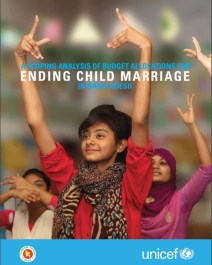
June, 2017: I worked with UNICEF’s social policy and gender & development sections in New York and the UNICEF country office in Dhaka on a study of the Bangladeshi government’s budgetary allocations and spending on interventions (education, child protection, health, etc.) which are known to reduce child marriage rates. The analysis was published as a joint report of UNICEF Bangladesh and the Bangladesh Bureau of Statistics.
One of the most depressing phenomena still afflicting the global population is the continued occurrence of child marriage around the world. According to UNICEF 12 millions girls are married below the age of 18 each year, while 650 million women alive today were married as children.
It ought not to require explanation, but child marriage robs millions of girls of their childhoods as well as significantly diminishes their chances at leading a fulfilling life in the future. As such reducing the incidence of child marriage around the world is one of the most important goals for the international development community.
One of the highest rates of child marriage is in Bangladesh. At 59%, the incidence of child marriage in Bangladesh is the fourth highest; behind only Central African Republic, Chad and Niger. Up until the last few years, the Government of Bangladesh had not in any serious way planned to address this challenge. More recently”the GoB has been undertaking several initiatives which include keeping girls in school; empowering adolescent boys and girls through provision of life skills based education; transferring cash to vulnerable families with adolescent girls; ensuring protection of children at risk; and raising awareness through community mobilization and behaviour change initiatives. The Government also led the important process of enacting the new Child Marriage Restraint Act in 2017, and finalizing a National Action Plan to End Child Marriage.”
This analysis was conducted by UNICEF in the above context. The objective of the exercise was to conduct a preliminary scoping analysis of the GoB’s budgetary allocations and spending on activities and programs which are usually associated with ending child marriage. This would provide for a useful baseline to work off of moving forward.
We found that the GoB’s most heavily invested relevant activities to end child marriage focused on welfare, adolescent health and secondary education for girls. Awareness raising and gender-based violence prevention programs existed but received relatively lower levels of funding. This is important because two of the main drivers of the child marriage phenomena are cultural attitudes and household concerns around their daughters’ vulnerability to GBV.
Relevant links:
- A Scoping Analysis of Budget Allocations for Ending Child Marriage in Bangladesh 2017. Bangladesh Bureau of Statistics and UNICEF Bangladesh 2017, Dhaka, Bangladesh
- UNICEF (2017) The state of the world’s children
- UNICEF data website
- Girls not brides
 Asif Saeed Memon