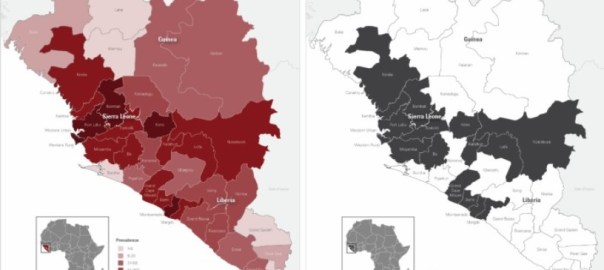
Using nine Demographic and Health Surveys for the three West African countries affected by the 2013−16 Ebola epidemic, this study applies a district-level interrupted time series (ITS) design to explore the longer-term impacts of the epidemic on school attendance. It shows that, about three to four years after the crisis, attendance has returned to the long-term trend regardless of the difference in Ebola virus disease prevalence among districts. The study also shows no discernable effect on the attendance trends for children from vulnerable backgrounds. However, it suggests further areas for examination and study. This includes migration patterns, the investment of emergency relief and overseas development aid between regions, the possible role of orphan status and early marriage (for girls) as vectors for the effect of the EVD crisis on educational outcomes and learnings losses for children who were out of school for up to an entire school year.
KEY FINDINGS This research brief is one of a series exploring the effects of COVID-19 on education. It focuses on how school closures affect children and the resiliency of education systems to respond to such disruptions and mitigate their effects.
Unexpected school closures are shown to negatively influence children’s learning outcomes. Whether and to what extent students may make up the learning losses varies over time. Some factors may include closure duration, quality of education before and after closure, proximity of the closure to a child’s schooling transition, and whether the child experienced a traumatic event.
Beyond the negative consequences on learning, school closures expose students to additional risks. Hundreds of millions of children rely on schools for free or low-price meals throughout the year. At the same time, school closures can expose children to violence (including sexual violence and forced marriage) at home and in their communities. Children’s need for psychosocial support also increases.
As it is likely the world will face more crises forcing schools to close, strengthening the resilience of education systems is a priority to mitigate the damage school closures have on children’s learning and well-being. Countries must build capacity to deliver quality education remotely, using a blended approach (with increased capacity of teachers) and targeting vulnerable and marginalized children who are often forgotten.
I recently worked with colleagues at UNICEF to pull together literature on the impact of school closures (one of the policy tools used to control the spread of the disease) on the infection rate as well as other indicators of interest. The blog was published on blogs.unicef.org on May 19, 2020.
By Asif Saeed Memon, Annika Rigole, Taleen Vartan Nakashian, Wongani Grace Taulo, Cirenia Chavez and Suguru Mizunoya
The COVID-19 pandemic has led to an education emergency of unprecedented global scale. At its peak, over 190 countries closed schools in response to the health emergency, leaving 9 out of 10 enrolled learners around the world out of school. Although previous health emergencies – such as the H1N1 influenza pandemic in 2009 and the Ebola outbreak in 2014-2016 – have caused short- and long-term school closures in several countries, the COVID-19 crisis has caught most of the world’s education systems unprepared. As a result, countries have been scrambling to implement immediate, wide-scale distance learning for the first time.
In this blog, we explore lessons from current and past school closures and call for investment to improve the resiliency of national education systems to respond to future disruptions and crises.
The effects of school closures on children
Whether closing schools is an effective policy for limiting the spread of infectious diseases largely depends on the epidemiology of the disease as well as demographic, geographic and social factors, as well as the presence of other community mitigation efforts. In terms of educational outcomes, disruptions in schooling can lead to significant losses in learning and to increases in grade repetition and school dropouts.
In the United States, even short, unexpected school closures due to bad winter weather have shown to negatively affect primary-school children’s learning outcomes. Research shows that during longer term disruptions, like those following Hurricane Katrina, primary and secondary students’ learning can take upwards of two years to recover to pre-disruption levels.
Beyond the negative consequences on learning, school closures expose students to additional risks. Hundreds of millions of children rely on schools for free or low-price meals, and a safe space. When schools close, many children face an increased risk of malnutrition. Despite an estimated 370 million children missing out on school meals, according to a recent survey of 129 UNICEF programme countries, only 41 per cent of countries reported that interventions in the area of nutrition and school feeding were part of their national response to COVID-19 as of May 1st. Many of the children who benefit from school meal programmes could already be nutrient deficient, vulnerable or at risk.
In addition, studies show that girls’ exposure to risks of sexual violence increased dramatically when schools were closed during the Ebola crisis. Sierra Leone saw a 65 per cent increase in adolescent pregnancies – a vector for early marriage as well as school dropouts – in some areas. Moreover, once schools re-opened, girls’ enrolment decreased by 16 per cent. Some students who needed to help their families with household work or generate income fell behind in school or simply never returned.
Distance learning has an opportunity to shine
Despite challenges and setbacks, learning can and does continue in times of crisis. Technology offers a wide variety of methods to support distance education. Which kinds of technology are most appropriate vary due to differing access among populations – particularly vulnerable groups – in a country or region. This decision tree outlines an avenue for considering which combinations of interventions may be needed, from paper-based approaches to online classrooms.
The same recent survey of UNICEF programme countries found that 93 per cent are incorporating distance learning in their national responses to the COVID-19 emergency. As depicted in Figure 1 below, TV education programming and government-supported online platforms are the most common methods employed, but most countries draw upon a combination of several methods to reach children However, 30 per cent of these programme countries reported that distance learning is not reaching vulnerable and marginalized children. Drawing on MICS6 data on access to Internet and broadcast media, two recent UNICEF blogs highlighted that relying on the internet alone will not ensure inclusive, equitable education. They found that television and radio broadcasts have the potential to reach a majority of the world’s children, especially the most vulnerable, but paper-based approaches remain a necessary alternative in some settings.
During the Ebola crisis, the government of Sierra Leone, with support from UNICEF and other partners, created the Emergency Radio Education Programme (EREP) to continue learning during the school closures. To reach vulnerable children, the government delivered 50,000 solar-powered radios to the poorest households across the country with USB ports for content provision in areas lacking radio signal coverage. The use of an existing supply chain designed for the distribution of voting materials proved effective for delivering the radios and supporting educational materials to households.
EREP household surveys showed that weekly listenership ranged from 40 to 80 per cent and was lowest during weeks that were normally school holidays. Families that did not engage with the radio content often cited that since the content was not examinable, it was of no value. This challenge – that governments cannot make distance education mandatory and examinable because it may discriminate against those who lack proper access – lingers during the current COVID-19 crisis.
Future preparedness and resilience
The education sector has rebuilt after natural disasters and delivered education during conflicts or in refugee settings; it is also increasingly adapting to climate change. However, COVID-19 is a global health emergency of unprecedented scale, presenting unique challenges that many countries were unprepared to address. While forms of distance education are now being delivered, only 30 per cent or fewer of countries report that they are monitoring take-up of distance education or whether children are learning.
As the world will likely face more health crises in the future, we must prioritise strengthening the resilience of education systems to mitigate the harm to children’s learning. Countries must build capacity to deliver quality education remotely, targeting vulnerable and marginalized children who are often forgotten. Once the current crisis subsides, countries must continue to scale up distance learning and incorporate aspects into everyday schooling for all children and youth.
Building on lessons learned from these school closures, they must create comprehensive preparedness plans and develop strong national infrastructure to deliver education through different modalities and monitor its reach and contribution to learning. Vigilance is essential to prevent children’s learning from falling through the cracks during this present crisis as well as future ones.
The COVID-19 pandemic continues to throw up challenges for policy makers around the world. In this time of uncertainty it is difficult to know what resources to help keep track off. Here is a (not very curated) list of resources to look at:
Data Visualizations
Johns Hopkins Universities’ highly regarded dashboard on global COVID-19 trends.
UNESCO has a dashboard focused on schooling disruption
Our world in data has an excellent set of data visualizations as well.
Visual Capitalist has an excellent set of infographics to help understand the magnitude COVID-19 pandemic relative to all known pandemics
Policy & Research focused content
A series of blogs on education, child protection, data ethics and more from UNICEF

 Asif Saeed Memon