Category Archives: Pakistan

The Pakistani Establishment vs the Pakistani Federation: The ‘New Administrative Units’ snake oil

Well … what an utter mess!

As if Pakistan didn’t have enough political, social, economic, environmental and geo-political problems already facing it; the establishment – in all its wisdom and using its very own Swiss Army Knife of a government official – has launched its latest assault on the Federation.

Apparently, all of Pakistan’s problems of governance and poor service delivery are caused by the unwieldy and large population sizes of its provinces. Therefore the solution to this problem is for a government official with no actual political constituency, to use the power of the center to impose an arbitrary partition of its federating provinces.

This isn’t the first time the Pakistani establishment has attacked the Pakistani federation. And it will not be the last. But that is what this is. It’s important to note that. This is the Pakistani establishment ATTACKING the Pakistani Federation and the Pakistani constitution.

They’ve done this before.

In 1948, the center ripped Karachi out of Sindh and converted it into the national capital. In 1955 they merged all the provinces AND princely states in West Pakistan into ‘one unit’. Then, when this was undone in 1970, none of the former princely states were recognized; simply absorbed into the surrounding provinces. Now they have released this trial balloon of partitionning the four provinces into 15-odd smaller ‘administrative units’.

And so, here we are. What an utter mess!

The whole idea is so ahistorical, so devoid of any understanding of the principles of federalism, so preposterous in tool they wish to establish consensus with (a national referendum) that it beggars belief.

First, the constituent parts of Pakistan are historical entities. They have their own peoples, languages, customs, food, and art. They have their own cultures. They have been Pakistan for almost eight decades. But they have been some version of their very own distinct lands and peoples for centuries. Random establishment flunkies cannot just announce that these lands and peoples have to be divided. The various lands and peoples of Pakistan cannot be divorced from their histories so easily; whatever the imagined governance expediencies might be.

Second, this is not how federalism works. The center may not alter the boundaries of any one of its federating units. The federating units have come together to create the whole. They have not handed over control of their boundaries to the center. This is protected by Article 239(4) of the constitution: ” A Bill to amend the Constitution which would have the effect of altering the limits of a Province shall not be presented to the President for assent unless it has been passed by the Provincial Assembly of that Province by the votes of not less than two-thirds of its total membership.”

When FATA was merged into Khyber-Pakhtunkhwa, the KP provincial assembly ratified the Twenty Fifth amendment bill with two-thirds majority in 2018, as per Article 239(4). This was the first and only time the boundaries of the constituent parts of Pakistan have been altered by constitutional means.

The Sindh provincial assembly has, on seven occasions, passed resolutions rejecting any partition of Sindh or any changes in its boundaries. First in 1948. Most recently, twice in 2026. Various political parties with strong constituencies in Balochistan and KP (ANP, BNP, NP and JUI-F) have warned against or outright opposed any such actions.

Third, the ridiculous idea of a national referendum on the subject falls apart on every test that may reasonably be applied. Constitutionally, it is a non-starter. Article 239(4) already provides a mechanism for altering provincial boundaries. It does not allow for a referendum on the subject.

Logically, it is nonsensical. Balochistan is approximately 6% of Pakistan’s population. If every single voter in the province opposes partition, but the rest of the country votes to carve it into ten pieces, should they accepts this fate? The people of Punjab or Sindh or Khyber-Pakhtunkhwa or Islamabad have no right to dictate to the people of Balochistan on how their province is to function. This would be colonialism, not federal democracy!

Finally, let us dispense of the blatant lie that this is needed for good governance or better service delivery. If you list all the largest provinces or states in all countries, Pakistan’s Punjab is the only one that cracks the top 20. There are many giant provinces and states in India, China and elsewhere. Some of them function well, others do not, with many in the middle. The only thing this partitioning will achieve is strengthen the power of the Pakistani establishment.

They are pushing this for their own self serving reasons. And Pakistan now has an additional political and a possible constitutional crisis on top of all the other crises it faces.

And so, here we are. What an utter mess!
Opinion: Think tanks in Pakistan

Feb 16, 2016: This blog (co-authored with my colleague, Mome Saleem) was published on the Think Tank Initiative’s website.

Pakistan has seen considerable growth in the number of think tanks operating in the country in the last decade. The 2014 Global Go To Think Tank Index Report counts 19 such institutions. This is a significant increase from the two or three found in the early 1990s. Despite this increase over the last two decades, it is difficult to measure the successful impact of these institutions on evidence based policy making in the federal and provincial capitals.

Continue reading Opinion: Think tanks in Pakistan →

On the effectiveness of foreign aid for education

July 6, 2015: I was quoted in a column on the lack of effectiveness of American aid for education in Pakistan by Nadia Naviwala. The quote is below:

“All aid funding for Pakistan continues to face one problem — it can’t circumvent the politics around education,” says Asif Saeed Memon, a doctoral candidate and research fellow at the Sustainable Development Policy Institute (SDPI). “For politicians, education is about patronage in two ways. One is teaching positions and the second is school construction, which is about awarding work to their favourite contractors.”

Opinion: 4 percent challenge

June 4, 2015: This column was published in Dawn’s opinion pages prior to the PML-N ministry’s third federal budget being announced.

The budget season is here. Like every year we’ll be hearing calls to increase the education budget. By now we all know that the Pakistani state — the federation as well as the provinces — spends a paltry 2pc of GDP on education.

By comparison, Bhutan spends over 5pc of its GDP on education and India 3.8pc. Countries in the West spend over 5pc while Scandinavian countries, often ranked at the top of international literacy and numeracy tables, spend in excess of 6pc.

Continue reading Opinion: 4 percent challenge →

Presentation: Launch of the Pakistan Data Portal at SDC 2014

December, 2014: At the 17th annual Sustainable Development Conference’s closing plenary I launched the Pakistan Data Portal. My team at SDPI had been working with our donors Alif Ailaan (DfID funded) on the data portal (a repository of education data in Pakistan) for the better part of the preceding year.

The PDP brought together government collected as well as privately collected data on education in Pakistan and collated them on the same platform for the first time.

Continue reading Presentation: Launch of the Pakistan Data Portal at SDC 2014 →

Budget analysis 2013

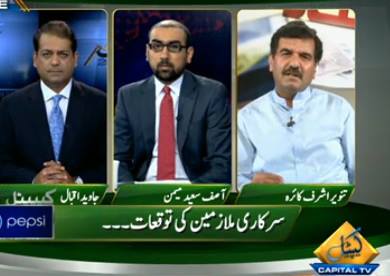
1016672_470909032993189_183670328_n

June 12, 2013: I appeared on Capital TV with Javed Iqbal along with the PPPP’s Tanveer Ashraf Kaira to discuss the first budget released by the newly elected PML-N administration of then Prime Minister Nawaz Sharif.

Minister of Finance Ishaq Dar had presented the finance bill in the national assembly on June 12th, just five days after Mr. Sharif had been sworn in as Prime Minister. The crux of my analysis was that this budget did not tell us much about what the third Sharif administration would look like over it’s full term.


Op-ed: The disappearing poor

July 29, 2012: This column was published in Dawn.

Poverty is the major challenge faced by developing economies. It represents, simultaneously, a failure on the part of the polity to improve the stock of the least fortunate amongst us as well as a considerable drag on the further expansion of the economy.

Perhaps more than any other indicator of success, poverty reduction is used to judge development policies. And the surest way of reducing poverty is rapid economic growth, despite legitimate criticism of the unequal distribution of economic growth between the wealthy and the poor. A rising tide lifts all boats, or so the argument goes. Economic growth is not by itself a panacea, but it is the integral ingredient.

Continue reading Op-ed: The disappearing poor →

Op-ed: Summer of discontent

May 4, 2010: This column was originally published in Dawn.

Things are about to get very rocky for the PPP-led governing coalition. That is remarkable considering the last two years have not exactly been smooth sailing.

Forget the judiciary, the media and the opposition. This summer the administration will face what may prove to be its nemesis the rolling power outrage. Continue reading Op-ed: Summer of discontent →

Op-ed: Economy, a top priority

April 22, 2010: This column was originally published in Dawn.

A FEW days ago, President Asif Ali Zardari affixed his signature to the 18th Amendment bill. Now that the political class of 2008 has successfully exorcised the ghosts of generals past from the constitution, perhaps the administration can focus on the two existential threats facing Pakistan jihadist militancy and economic malaise. Continue reading Op-ed: Economy, a top priority →