May 2014: Alif Ailaan and SDPI launched the second district education rankings in May, 2014 in Islamabad. As with the previous year ‘s rankings, the data was drawn from both government and private datsets. This was the first year that comparisons could be made to the previous year’s data in order to gauge progress.
All posts by asifsaeedmemon

Presentation: Symposium on inclusive growth, Colombo
November 2013: I facilitated a panel on economic growth within natural limits hosted by the Center for Poverty Analysis (CEPA) in Colombo.
My presentation is here: Economic growth within natural limits.
Continue reading Presentation: Symposium on inclusive growth, Colombo
Budget analysis 2013
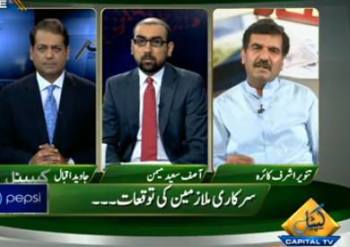
June 12, 2013: I appeared on Capital TV with Javed Iqbal along with the PPPP’s Tanveer Ashraf Kaira to discuss the first budget released by the newly elected PML-N administration of then Prime Minister Nawaz Sharif.
Minister of Finance Ishaq Dar had presented the finance bill in the national assembly on June 12th, just five days after Mr. Sharif had been sworn in as Prime Minister. The crux of my analysis was that this budget did not tell us much about what the third Sharif administration would look like over it’s full term.
Research: Alif Ailaan Pakistan district education rankings 2013
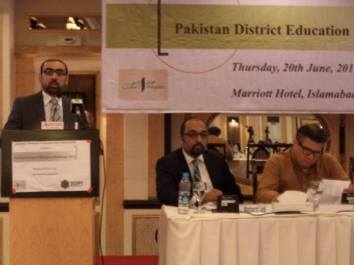 May 2013: Alif Ailaan – a DfID funded, education focused data and advocacy campaign – and the Sustainable Development Policy Institute (SDPI) – an Islamabad based Pakistani think tank launched the first ever Pakistan District Education Rankings in May of 2013.
I was the lead author on the report and led the data team which collated the data and produced the report. The rankings were based on a similar approach used by UNESCO for their international education index. The data were gathered from two government and one private datasets and two different education indices were calculated.
Continue reading Research: Alif Ailaan Pakistan district education rankings 2013
Op-ed: On local government
April 23, 2013: This column was published in Dawn.
In the shadow of a half-constructed multi-story plaza between two empty plots strewn with construction rubble, sits a shabby looking shed of concrete blocks and corrugated iron roof.
Inside, under the pale glow of an energy saver light bulb sits a shalwar kameez clad grade-7 official tapping away at a battered desktop computer. Meet Mr Kaleem (real names have been changed on request), secretary of his union council in Sialkot. He is surrounded by some locals with documents to be attested or corrected.
Op-ed: A public health disaster
April 15, 2013: This column was published in Dawn.
A number of months have now passed since the apparently coordinated attacks in Karachi and Peshawar which left five health workers and volunteers dead.
The deceased — mostly young women — were working on a national campaign for the eradication of polio, coordinated by provincial and federal governments.
As a response to the attacks, the governments of Sindh and Khyber Pakhtunkhwa suspended the campaign for a short period, while the United Nations removed some of its field personnel until they could receive guarantees of better security.
Research: AAWAZ baseline studies
Jan – Feb, 2013: From 2012 to 2014 I worked on monitoring and evaluation for the AAWAZ programme (for the Sustainable Development Policy Institute) in Islamabad. AAWAZ was a DfID social accountability program which was to expand to 45 districts across Khyber Pakhtunkhwa and the Punjab by the end of its first five years in 2017.
Op-ed: The disappearing poor
July 29, 2012: This column was published in Dawn.
Poverty is the major challenge faced by developing economies. It represents, simultaneously, a failure on the part of the polity to improve the stock of the least fortunate amongst us as well as a considerable drag on the further expansion of the economy.
Perhaps more than any other indicator of success, poverty reduction is used to judge development policies. And the surest way of reducing poverty is rapid economic growth, despite legitimate criticism of the unequal distribution of economic growth between the wealthy and the poor. A rising tide lifts all boats, or so the argument goes. Economic growth is not by itself a panacea, but it is the integral ingredient.
Op-ed: Policymaking with blindfolds
July 19, 2012: This column was originally published in Dawn.
Earlier this year officials at the federal Ministry of Finance and the Pakistan Bureau of Statistics (PBS) had a disagreement.
The disagreement was due to a rebasing (changing the base year, a statistical procedure required to discount economic indicators for inflation) that the PBS had recently conducted and with which the finance ministry was not pleased. It changed the base fiscal year from 1999-00 to 2005-06.
Op-ed: Taming the HEC
July 3, 2012: This column was originally published in Dawn.
They tried devolving it but the courts and coalitionists blocked them. They’ve been starving it for funds but it still hobbles along. Now they want to bring it to heel.
It has been this way for the Higher Education Commission (HEC) ever since the 18th Amendment devolved the federal role in education to the provinces two years ago.
 Asif Saeed Memon